

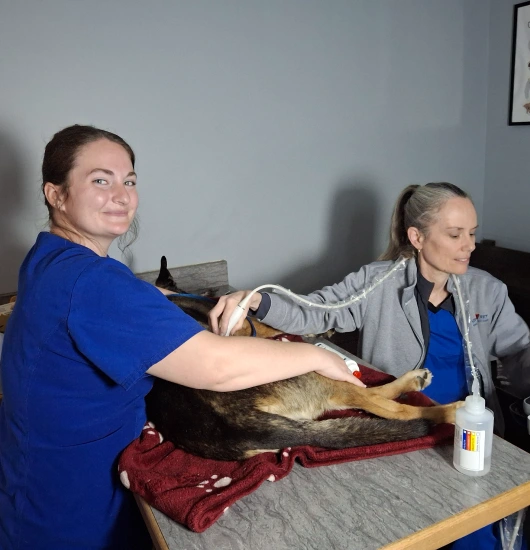

Does Your Pet Need Specialized Diagnostic Testing?

When an animal family member isn’t feeling well, it can be stressful for everyone. Having to bring your pet to a specialty clinic where he or she is not familiar or comfortable can only make matters worse. At Paw Prints Animal Hospital, we want our patients to receive the care they need in a way that minimizes stress as much as possible. That’s why we’ve partnered with a local veterinary specialist. Not only is this more convenient for you, but it’s also much better for your pet.
Meet Our Expert: Dr. Laura Cousins
Board-Certified Internal Medicine SpecialistDr. Laura Cousins is our primary ultrasonographer at Paw Prints Animal Hospital. With over two decades of experience, Dr. Cousins
performs both abdominal ultrasounds and echocardiograms for our furry patients. She has extensive expertise in cardiac imaging and has taught ultrasound Continuing Education (CE) to veterinarians. Her vast experience allows her to provide in-house ultrasound interpretation and detailed written reports, ensuring that your pet gets the best care possible.
Types of Ultrasounds We Offer
Ultrasound imaging provides a non-invasive way to examine the inside of your pet’s body and diagnose potential health concerns. It is safe and painless, yet offers highly-accurate images that allow us to evaluate how your pet’s body is functioning.
- Abdominal Ultrasound: This non-invasive procedure helps us examine your pet’s abdominal organs, such as the liver, kidneys, pancreas, and spleen, to diagnose conditions like chronic GI disease, urinary tract issues, abdominal masses, or endocrine concerns like Cushing's disease.
- Echocardiogram (Cardiac Ultrasound): We offer echocardiograms to evaluate your pet's heart, especially if they have a heart murmur, are breed predisposed to cardiac disease, or show signs of early-stage heart disease. This ultrasound allows us to measure heart chamber size, wall thickness, fractional shortening or systolic function, and valve function—providing more detailed information than X-rays.
- Single-organ or Focused Studies: These focused ultrasounds help assess specific organs in greater detail. They can be beneficial for conditions like abdominal masses or suspected urinary tract disease.
- Pregnancy Ultrasound: We offer pregnancy ultrasounds to confirm whether your pet is expecting. Please note that we do not perform detailed fetal evaluations but can confirm pregnancy status.
When is Ultrasound Recommended?
Abdominal Ultrasound is recommended for:
- Chronic or acute GI signs
- Elevated liver enzymes or abnormal lab work
- Suspected urinary tract disease
- Endocrine concerns like Cushing's disease
- Cancer staging
- Abdominal masses or abnormalities
Echocardiograms are recommended for:
- Heart murmurs
- Breed predisposition to cardiac disease
- Suspected acquired or early-stage heart disease
Understanding the Role of Sedation in Ultrasound
Sedation for ultrasound procedures is determined by the attending veterinarian, and Dr. Cousins
does not make sedation decisions herself. For Paw Prints patients, injectable sedation may be used if necessary. For outpatient ultrasounds, the referring veterinarian provides sedation (oral sedatives if required). In mobile appointments, sedation is managed by the referring veterinarian. Echocardiograms generally do not require shaving, but abdominal ultrasounds may require shaving to ensure clear imaging.
Information Needed Before the Ultrasound
To ensure we have all the details for an effective ultrasound, please provide:
- Medical history and timeline of symptoms
- Previous treatments and responses
- Labwork and any recent radiographs
- Current medications and weight
- Differential diagnoses or goals for the ultrasound
Why Choose Ultrasound Over X-ray?
For Cardiac Conditions:
- Ultrasound offers a detailed analysis of heart chamber size, wall thickness, ejection fraction, and valve function—unlike X-rays, which only show the heart's shape and size.
- Ultrasound allows for precise staging, treatment planning, and monitoring, especially for heart disease.
For Abdominal Conditions:
- Ultrasound visualizes internal organs and can detect structures not visible on X-rays (e.g., pancreas, adrenal glands).
- X-rays only show organ outlines, while ultrasound provides detailed imagery, showing wall thickness and organ architecture.
Fasting Guidelines for Your Pet’s Ultrasound
To ensure the accuracy of an abdominal ultrasound, your pet must fast from midnight the night before. There are exceptions for pets with special needs, such as diabetic, pediatric, or hypoglycemic conditions. In these cases, a vet-to-vet consultation with Dr. Cousins
will be arranged to determine the best course of action.
Scheduling Your Ultrasound Appointment
For a smooth experience, we recommend drop-off appointments, allowing us the time to focus on your pet’s needs. However, you’re welcome to wait in our lobby, though the results will typically be available at pick-up or by the next business day. Booking an ultrasound is simple—just call our office.
If your pet has been acting unusual lately and you’re concerned, it may benefit from advanced imaging, including ultrasound, contact us right away. We can conduct the necessary testing and arrange for in-clinic specialized care as needed. Call today to learn more.
When Can You Book?
Monday and Wednesday mornings
What’s the Cost?
Echocardiograms - $585
Abdominal Ultrasound - $485
Note: Prices may vary based on your pet’s needs
Trusted Veterinary Care for Pets and the People Who Love Them
Schedule A Visit!
